Somewhere on the twelfth of this month, a line was drawn across the top of the world — through the Arctic, down the eastern edge of Greenland, across a strip of Iceland, and into a corner of northern Spain barely wide enough to hold a small province. On one side of that line, for a little over two minutes, the sun went out and the stars came up in the afternoon. On the other side of that line — a few hundred miles away, sometimes less — the sky merely dimmed, the way it does before a summer storm that decides against itself. The line did not care which side you were on. It only cared where you were standing.
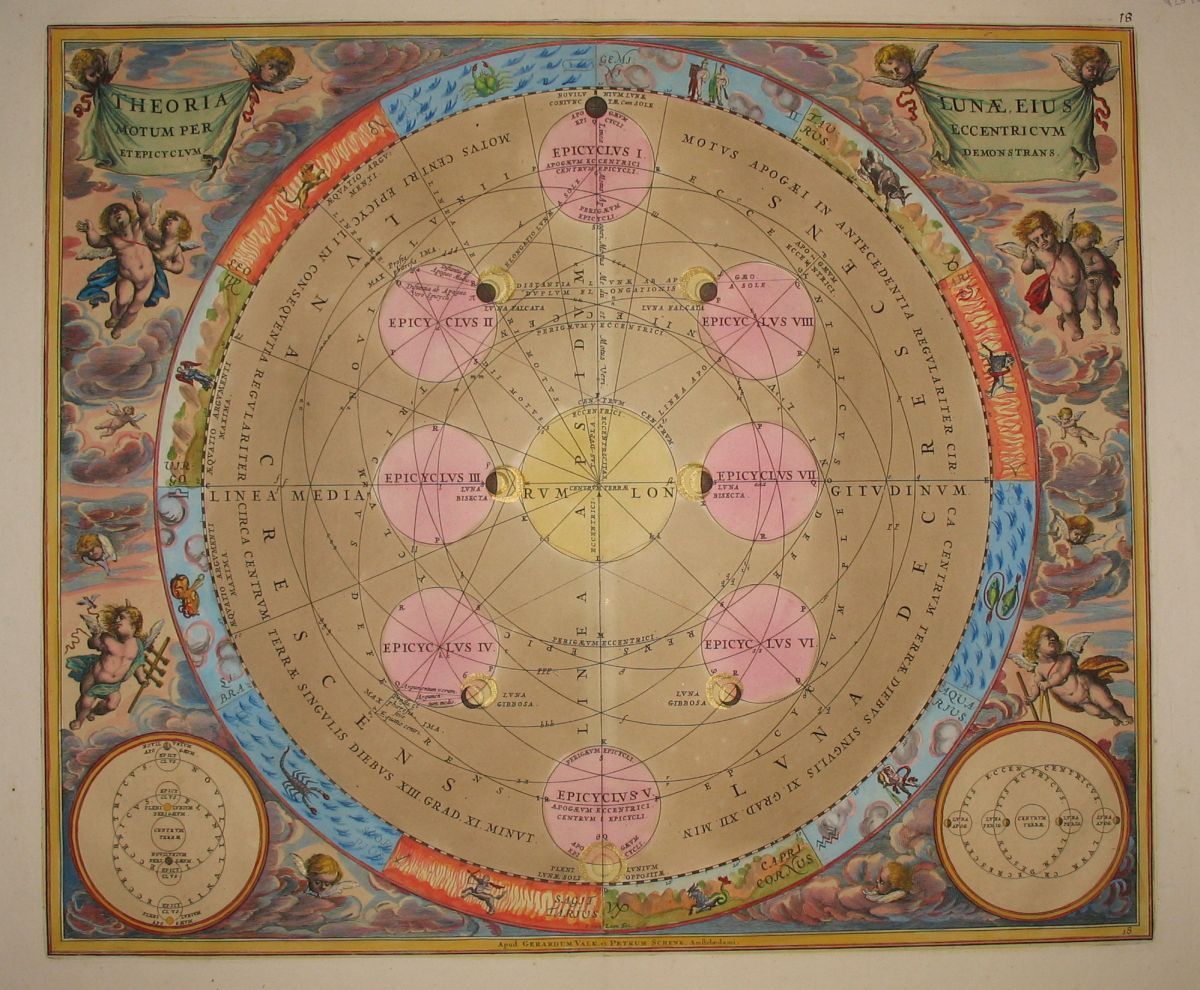
I have an old chart, reproduced from a book much older than the country I live in, showing the orbits of the moon and the arithmetic of eclipses laid out in copper-engraved circles, as though the sky could be filed like a ledger. The men who drew it — working in Amsterdam in 1660, long before anyone could predict an eclipse to the minute, let alone the mile — believed the heavens ran on a fixed and knowable geometry, and they were right, which is the unsettling part. The universe really does keep a ledger. It simply does not consult you about where the line falls.
Borges, who went blind slowly enough to watch it happen, wrote often about the line between the thing you can see and the thing you cannot — the line between the map and the territory, the line between the infinite library and the one shelf you can actually reach. He would have found the eclipse's line of totality unbearably tidy: a border, drawn by physics rather than treaty, that a man could miss by the width of a county and never know the difference except by reading about it later, the way I am reading about Reykjavík now, four thousand miles from where the sky went dark on schedule.
There is a kind of humility particular to standing just outside a line like that. You did not fail to see totality through any fault of attention or virtue. You were simply elsewhere, and elsewhere, on the day the shadow crossed the earth, was ordinary daylight, slightly dimmed, easily missed if you didn't know to look up. Most of what happens to us is like this — not the dramatic total darkness, but the partial dimming a few hundred miles from where the real thing occurred, close enough to hear about it, too far to have stood in it.
The old chart still hangs where I can see it. It does not know about Iceland or Spain or Chatham County. It only knows that the moon and the sun keep an appointment with each other on a schedule fixed since before there were counties, or countries, or men willing to stand in a field with cardboard glasses waiting for a shadow that, this time, was headed somewhere else.
Join the conversation.
Login RegisterNo comments yet. Be the first to leave a mark.