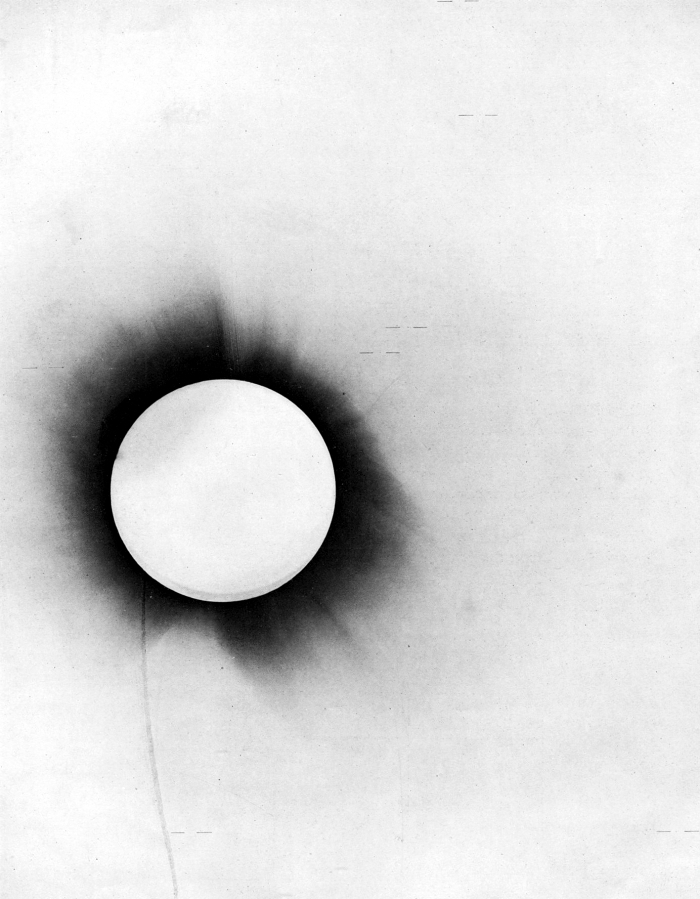
A friend who teaches astronomy at the science museum in Durham pulled this up on her laptop the same week the moon crossed over Iceland — a negative, all inverted light and shadow, of the total eclipse photographed in 1919 by a team led by an Englishman named Eddington. That plate, more than a hundred years old now, is the reason we know starlight bends around the sun exactly as much as a patent clerk in Switzerland, thinking it through with nothing but a pencil, once calculated it should. They had to wait for the moon to block out the sun's glare to prove it. The whole of general relativity, confirmed, on a piece of glass the size of a dinner plate, during a few borrowed minutes of darkness off the coast of Africa.
I keep thinking about the negative itself — not the discovery, which everybody already knows, but the object. Black where the sky was light. Light where the stars, bent slightly out of their true position, managed to leave a mark anyway. It is the closest thing I have seen to a photograph of an argument being won.
Join the conversation.
Login RegisterNo comments yet. Be the first to leave a mark.